







Text or pictures from this site may not be used or reproduced without consent and proper citation. Please send comments or suggestions to the webmaster, yanglab (at) princeton.edu.
Original website designed in 2009 by Freckles Studio/HY; revised in 2026 by HY.


Control of Artificial Swimmers and Active Matter
"Photon nudging" is a new way of controlling and navigating self-propelled miniature swimmers in solution. It works by manipulating the nanoscale fluidic properties around the swimmer and exploiting the omnipresent thermal fluctuations. We continue to extend the technology to three dimensions and to the nanoscale, while investigating the underlying physics, the engineering aspects, and applications in physical biology.
Technical Advances Made
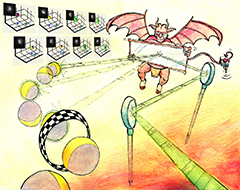
Photon-nudging conceptualization, experimental realization, and theories
This work demonstrated, for the first time, intelligent control of a single self-propelled micro-swimmer. It realizes stochastic control of autonomous micro-swimmers in low-Reynolds-number fluids and points to new ways of studying microbial locomotion.
Links:
Chem. Sci., 4, 1420–1429 (2013): first control of individual micro-swimmers;
Phys. Chem. Chem. Phys., 20, 10502–10520 (2018): theory I;
Phys. Chem. Chem. Phys., 20, 10521–10532 (2018): theory II.
Contributions to Scientific Problems
Far-from-equilibrium physics:
Direct experimental verification of the "Hot Brownian Motion" theory
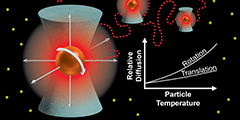
The conventional formulation for Brownian diffusion is based on the premise that the system is under thermal equilibrium, or near equilibrium. It breaks down when the system is far from equilibrium, e.g., a steady-state heat source that is free to move and rotate in solution. The 'hot Brownian motion' (HBM) model is a theoretical framework put forward by Prof. Dr. Klaus Kroy and coworkers in 2010–2011. It provides an analytical structure to allow the direct application of the Stokes–Einstein formulation to a mobile heat source. Over the years, different aspects of the HBM theory have found support through various experiments; yet, it has lacked a consistent experimental test for the most fundamental prediction of the HBM theory—the temperature-dependent divergence of translational and rotational diffusivity of single nanoparticles. This contribution provided such experimental data and directly verified the HBM quantitative prediction for the translation–rotation diffusivity divergence without any adjustable parameters.
Updated: 2026.11.07.